A DJ contract is the difference between a booking you can rely on and a handshake that falls apart the moment something changes. Whether you are playing your first paid wedding or negotiating a club slot, putting the terms in writing protects you, protects your client, and signals that you run a real business. This guide explains what a DJ contract is, the clauses that matter, how agreements differ across booking types, and the mistakes that catch DJs out.
This article is general educational information, not legal advice. Contract and consumer law varies significantly by country, state, and jurisdiction, and the conventions described here are common industry practice rather than universal rules. For your specific situation — and before relying on any template — consult a qualified lawyer who can review or draft your contracts.
What a DJ contract actually is
A DJ contract — also called a DJ performance agreement, DJ booking contract, or DJ service contract — is a written agreement between a DJ and the person or organisation booking them: a private client, a venue, a promoter, or a booking agency. It sets out the terms of a single booking: who is performing, what they will do, when and where, how much they are paid, and what happens if something changes or goes wrong.
In common-law jurisdictions, a contract is formed when there is an offer, acceptance, an intention to be legally bound, and consideration — something of value exchanged by each side, here the performance in return for the fee. As the Wikipedia entry on contracts notes, verbal contracts are generally binding in most common-law systems, but they are hard to prove. The practical value of a written DJ contract is evidence: it records exactly what both parties agreed, so a misunderstanding does not become a dispute and a dispute does not become your word against theirs.
A DJ contract becomes legally binding once both parties sign and agree to its terms. It does not have to be long or full of legalese — even a one-page agreement covering date, times, fee, and cancellation is far better than nothing. The point is the move from we shook on it to we both signed it.

Why every working DJ needs one
The advice to always work from a written agreement is remarkably consistent across DJ-education and wedding-industry sources. A contract does several jobs at once.
It prevents disputes by putting expectations in writing. Digital DJ Tips' managing editor Joey Santos describes turning up to an early wedding gig expecting to spin the afterparty, only to be handed a microphone and told to host the whole dinner and reception — work he could have charged more for had it been agreed in writing. As he puts it in Digital DJ Tips' guide to DJ contracts, you can talk and shake hands with a client all you like, but if it isn't in a mutually agreed document, it doesn't hold water.
It helps ensure you get paid. A signed contract is the evidence you produce if a promoter or client fails to pay the agreed balance. Santos recounts two poorly organised festivals where the acts who had drawn up contracts were paid while everyone else's fees were left pending indefinitely.
It protects against cancellations and the unexpected. Santos was setting up for a wedding when the Taal volcano erupted nearby in the Philippines; the reception was cancelled, but he was still paid in full because a contract had been executed months earlier.
It signals professionalism. Both the American Disc Jockey Association (ADJA) and the United States Disc Jockey Association list using a clear written contract among the standards of a professional operator. The ADJA's code of professional conduct commits members to use a written contract that clearly states all charges, services, products, performance expectations and other essential information.
Finally, a contract provides legal recourse if either side breaches the deal — though, as several DJ lawyers stress, a contract is a tool, not a guarantee, and what is enforceable depends on your jurisdiction.
The key clauses, explained
The heart of any DJ contract is its clauses. The components below appear consistently across reputable DJ-contract and service-contract templates. Treat them as a checklist of what a thorough agreement covers, not as legal wording to copy.
Parties, event details, and scope
Parties and contact details. The full legal names, addresses, and contact information of both the DJ (service provider) and the client. This avoids any confusion about who is performing and who is paying.
Event details. The date, venue name and address, event type, and the specific start and end times — including how long the set or performance lasts. Vague timing is one of the most common sources of dispute.
Scope of services (what the DJ provides). A clear description of exactly what the DJ will do: DJing, and whether that includes MC/announcement duties, providing a PA, lighting, the number of hours, and music handling such as a must-play and do-not-play list. Spelling out scope prevents the can-you-also-host-the-whole-night surprise.
What the client or venue provides. The flip side: power supply, adequate space and a sturdy table, setup and breakdown time, and — depending on the booking — house gear, parking, meals for long events, and security. For private and outdoor events this often includes shelter from weather.
Money: fee, deposit, and overtime
Fee and payment terms. The total fee, the deposit amount, the balance and when it is due, and the accepted payment method. (For how to set the fee itself, see How Much DJs Charge.) A common structure is a deposit at signing and the balance due before or on the event date; many wedding DJs require the balance shortly before the event rather than after.
Deposit or retainer. An upfront payment that secures the date. Across wedding-industry sources this is commonly cited as roughly 25 to 50% of the total fee. With The Knot putting the average wedding DJ around $1,800, a typical 25 to 50% deposit works out to roughly $450 to $900 — a figure Platinum Pianist's 2026 guide reaches the same way, pairing a standard 25 to 50% range with that $1,800 average. The ADJA's consumer guidance goes further, advising clients to ask for a written agreement especially when paying an initial retainer, and noting that the standard initial payment for entertainment services is 50%. Treat any figure as a typical range, not a rule. There is also a meaningful legal distinction here: a deposit is often presumed refundable in some circumstances, while a retainer or booking fee is generally understood to be non-refundable because it compensates the DJ for holding the date and turning away other work. Several legal-information sources recommend the term retainer and clear, specific wording over the looser word deposit — but enforceability ultimately depends on the exact language and your jurisdiction, which is another reason to have a lawyer review yours.
Overtime. A stated hourly rate (often pro-rated for partial hours) for performance beyond the agreed end time. Without it, you either play for free or have an awkward negotiation mid-event.
Risk: cancellation, force majeure, liability
Cancellation and refund policy. What happens if the client cancels — typically a forfeited deposit, often with tiered terms where cancelling closer to the date means owing more, because the DJ is less likely to rebook. And what happens if the DJ cancels — commonly providing a suitable, client-approved replacement, or refunding monies paid. Many real-world disputes documented on wedding forums trace back to a cancellation clause that was one-sided or simply never read.
Rescheduling, postponement, and force majeure. A force majeure clause excuses performance for events beyond either party's reasonable control — acts of God, severe weather, venue closure, or public health orders. These provisions sat quietly in the boilerplate and were rarely negotiated until the COVID-19 pandemic thrust them into the mainstream, when event after event was cancelled and businesses scrambled to see whether their contracts covered a pandemic. Many modern contracts now explicitly list epidemics and offer rescheduling or credit toward a new date as the remedy.
Liability, insurance, and indemnity. Clauses that limit the DJ's liability and address who is responsible for injury or damage. Many venues now require DJs to carry public/general liability insurance and show a certificate of insurance before they can load in — coverage that responds if a guest trips over a cable or your gear damages the venue. Note that general liability typically does not cover damage to your own equipment; that needs separate gear cover.
Equipment, safe working conditions, and substitution. Who is liable for the gear, a requirement for safe working conditions, and a contingency for DJ illness — usually the right to send an approved substitute. The ADJA's standards include providing a safe work environment with adequate protection for clients and their guests.
Miscellaneous. Recording and promotional/photo rights, exclusivity, governing law and jurisdiction, dispute resolution (often mediation first), an entire-agreement clause, amendments in writing only, and — essentially — signatures and the date.
Here is a compact reference to the core clauses.
| Clause | What it covers |
|---|---|
| Parties & details | Legal names, addresses, contact info of DJ and client |
| Event details | Date, venue, event type, start/end times, set length |
| Scope of services | DJing, MC, gear, lighting, hours, music handling |
| Client/venue provides | Power, space, setup time, parking, meals, security |
| Fee & payment | Total fee, balance, due dates, payment method |
| Deposit / retainer | Upfront, date-securing payment; often non-refundable |
| Cancellation | What each party owes if they cancel; tiered by notice |
| Force majeure | Relief and rescheduling for events beyond control |
| Liability & insurance | Limits, injury, public liability, equipment damage |
| Overtime | Rate for performing past the agreed end time |
| Miscellaneous | Recording rights, governing law, signatures, date |
How contracts differ by booking type
The same core ideas apply across bookings, but who supplies the contract and where the detail sits changes with the type of work.
Private events and weddings. This is the most contract-critical category for working DJs, and here the DJ usually supplies the contract. As Wikipedia's entry on mobile DJs notes, these are DJs who tour with their own portable sound, lighting, and video systems for weddings, parties, and corporate events — and their agreements tend to be the most detailed: deposit/retainer, precise services and hours, gear provided, must-play and do-not-play lists, MC duties, attire, cancellation, and force majeure. Wedding-vendor guidance from The Knot and others consistently tells couples to nail down the contract terms — deposit, overtime, cancellation policy — in writing before booking.
Club and promoter bookings. Here the agreement often comes from the venue or promoter as a booking confirmation or performance agreement, and it can be simpler: fee, set time, date, and the DJ's rider. In electronic-music booking, much of this flows through an advancing stage where production details — technical rider, hospitality, schedule — are locked in before the night.
Agency and booking-agent contracts. A booking agent works on commission, and the separate representation agreement between a DJ and an agency is its own document. Commission commonly runs 10 to 20% of the artist's gross performance fee (before expenses); per booking platform Stagent, emerging artists often pay higher commissions of 15 to 20% while established artists with strong demand may negotiate lower rates of 10 to 15%, and the cut is usually calculated on the performance fee before expenses. Watch the exclusivity (does the agent take a cut of gigs you booked yourself?), the territory, the term (1 to 3 years is common; agents often push for longer), and any sunset clause that keeps commission running after you leave. The clearest red flag: legitimate agents earn commission only when you get paid and never charge upfront fees.
Bigger and touring gigs. At club level and above, the performance contract carries attached riders — technical and hospitality — and is typically negotiated by the agent with the venue's talent buyer, covering load-in, soundcheck, set length, and fee.
A quick reference for who usually drafts the agreement.
| Booking type | Who usually provides the contract |
|---|---|
| Private event / wedding | The DJ (detailed service contract) |
| Club / promoter | The venue or promoter (booking confirmation) |
| Via a booking agency | The agency (representation + performance contracts) |
| Festival / touring | Promoter/agent (performance contract + riders) |
The technical (and hospitality) rider
A rider is a document attached to the performance contract that specifies a performer's requirements. As the Wikipedia entry on riders explains, the two main types are technical and hospitality, and what a performer can demand scales with their status.
A DJ's technical rider lists the gear and booth setup needed to perform — for most club DJs that means industry-standard players and a club-standard mixer (for example, Pioneer CDJ players linked together and a Pioneer DJM mixer), one or two booth monitors with independent volume control, enough power sockets, a sturdy table at the right height, and booth lighting. The DJ sends it to the promoter, whose job is to make sure everything is in place; a clear rider means you can turn up and perform without discovering incompatible gear at the last minute. Listing acceptable alternatives (a fallback player or mixer) keeps you bookable at smaller venues.
A hospitality rider covers comfort and logistics — green room, water and refreshments, food or a buyout, accommodation, transport, and guest-list spots — and is most relevant for out-of-town and touring shows. Industry voices repeatedly warn that riders should be proportionate to the gig: extreme or brand-specific demands at a small club get talked about, and not in a good way. For the gear context behind a rider, see Building a DJ Press Kit (where a tech rider sits within your EPK) and Connecting to a Club Sound System.
How to handle contracts in practice
A few habits separate DJs who rarely have problems from those who keep getting burned:
• Always get written terms before the gig, even a simple one, for any paid work — and especially for private events.
• Use a clear template and customise it per booking rather than hunting for a new one each time. Build one solid agreement you trust.
• Read any contract you are given before signing — venue, promoter, and agency contracts are written to protect the other side. Wedding forums are full of couples and DJs who signed first and read later.
• Send the contract promptly with the deposit invoice, and don't perform private work without agreed, signed terms.
• Keep copies and store them somewhere accessible; both parties should retain a signed copy.
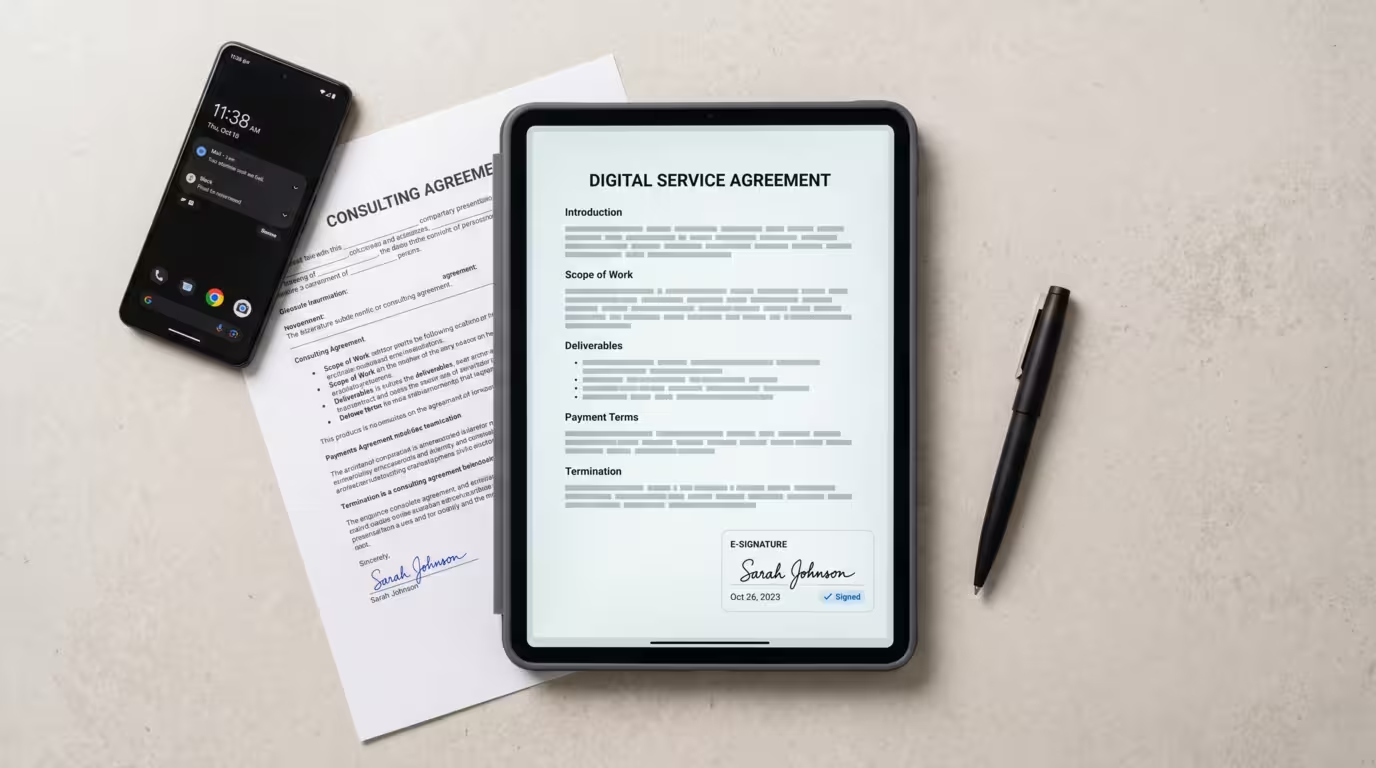
• E-signature and contract-management tools exist and make signing and storage easy — use whichever you like, but the tool matters less than the habit.
• Get a lawyer involved for complex, high-value, or long-term deals — residencies, branded events, festival slots, multi-date commitments, and agency representation agreements all justify a professional review.
Red flags and common mistakes
Most DJ-contract problems come down to a short list of avoidable errors.
| Red flag / mistake | Why it bites you |
|---|---|
| No contract (handshake deal) | Nothing to prove the terms; hard to get paid or resolve disputes |
| Vague fee, times, or scope | "Can you also host?" and disputes over hours and pay |
| No deposit / retainer | No protection if the client walks; date held for nothing |
| No cancellation or force-majeure clause | No agreed outcome when plans collapse or disaster strikes |
| Signing without reading | You're bound by one-sided venue or agency terms you missed |
| Overbroad or perpetual exclusivity | Agency takes a cut of work you sourced, for too long |
| Unclear overtime / what's included | Free extra hours or awkward mid-event renegotiation |
| Not keeping copies | No record when memories conflict |
On the venue and agency side, watch specifically for clauses that let the other party withhold pay unfairly, cancellation terms that are heavily one-sided, exclusivity that is broader than it needs to be, and — with agents — any demand for upfront fees. The practical fix for all of these is the same: read carefully, negotiate before signing, and walk away from a deal that won't put fair terms in writing. As one DJ-contract guide puts it, a client who will not put terms in writing is a client who can change those terms at any time.
The positive version is simple: use a solid template, keep it clear and fair to both sides, always pair a deposit/retainer with signed written terms, read before you sign, customise per gig, keep your records, and get legal help for the big and complex deals.
Key takeaways
• A DJ contract is a written performance agreement that records who, what, when, where, how much, and what happens if things change — protecting both sides and replacing unreliable handshakes.
• The core clauses are parties, event details, scope, fee, deposit/retainer, cancellation, force majeure, liability/insurance, overtime, and signatures; a deposit of roughly 25 to 50% is a common range, not a fixed rule.
• Who supplies the contract varies: the DJ for private/wedding work, the venue or promoter for club gigs, and the agency (commission commonly 10 to 20% of the fee) for agented bookings.
• A technical rider specifies the gear and booth you need; a hospitality rider covers comfort and travel — both scale with your status and should stay proportionate to the gig.
• Always get it in writing, read before signing, keep copies, and consult a qualified lawyer for high-value or complex deals — this article is general information, not legal advice, and the law varies by jurisdiction.
Ready-made, exclusive EDM tracks with full rights — released as your own.
