Stepping onto a festival stage is one of the biggest leaps a working DJ can make, and it is not simply a louder version of your club night. A festival set compresses your identity into a short, high-energy window in front of a huge, diverse crowd, on a big-production stage with its own rules, engineers, and risks. This guide focuses on what is genuinely different about festivals — and how to walk on prepared. It builds on the foundations covered in Building a DJ Set, Warm-Up, Peak-Time, and Closing Sets, and Reading the Crowd, so lean on those for the underlying theory.
How a festival set differs from a club
The core difference is one of scale and compression. A club night can be an intimate, slow-burning journey over two, three, or four hours, where you are close to the dancefloor and can patiently shape the mood. A festival slot is short, elevated, and built around moments. As Pioneer DJ's own guide puts it, festival sets are usually much shorter than club sets — sometimes only an hour long. You are often playing in daylight or early evening rather than a dark room, to people who came for the whole lineup and the experience, not necessarily for you.
David Guetta summed up the energy gap in a WIRED interview: clubs are where you can explore deeper, more underground sounds, but at a festival people want to hear exactly your sound, because that is what they bought tickets for — and because the crowd is so much bigger, you have to play with more energy, since it takes far more to move a hundred thousand people than two hundred. Outdoors there are no walls to contain the sound, the stage puts physical distance between you and the crowd, and elaborate visuals, lighting, and a massive PA turn the set into a spectacle rather than a conversation.
Here is the contrast at a glance.
| Aspect | Club set | Festival set |
|---|---|---|
| Length | Often 1-4 hours | Often ~45-90 minutes |
| Crowd | Smaller, dedicated, there for you | Huge, diverse, there for the lineup |
| Approach | Slow build, long journey | Get to energy fast, hit the moments |
| Setting | Dark, intimate, close to floor | Daytime/evening, elevated stage, distance |
| Sound | Contained room | Open air, wind and temperature affect it |
| Show | Music-led | Production-led: visuals, lights, spectacle |
This is a spectrum, not a binary. A boutique forest stage or an underground festival tent can feel close to a club, with a crowd of heads and freedom to take risks. A giant commercial EDM mainstage is the opposite extreme. Tailor your thinking to the stage you are actually on.
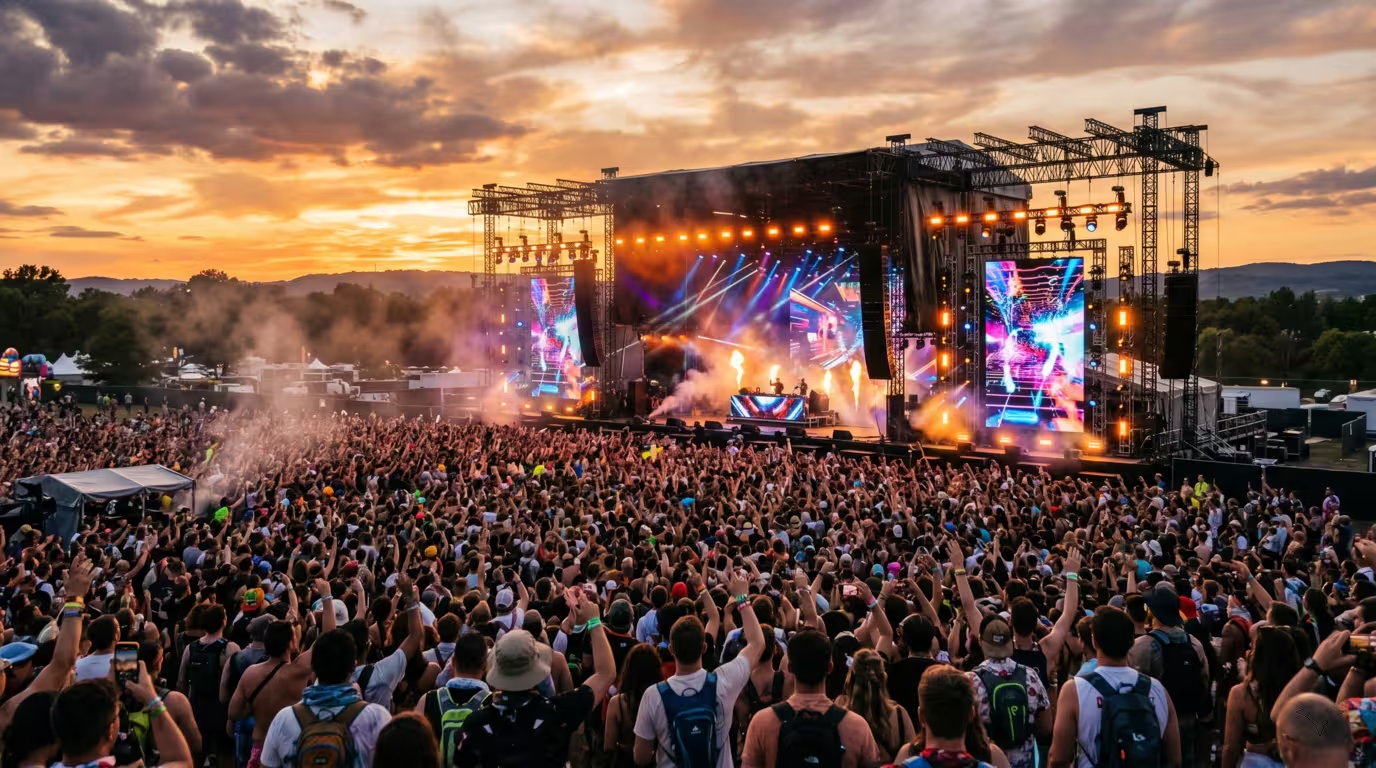
Programming the short slot
A short slot changes everything about structure. You cannot run a patient warm-up-to-peak arc when you have an hour or less — you have to get to the energy quickly and deliver your highlights. DJ and producer IMOGEN, speaking to Pioneer DJ, described the festival mindset perfectly: many in the crowd aren't there specifically to see you, and it might be their first time hearing you, so she squeezes in roughly the same number of bangers she'd play across a four-hour set, just compressed into one hour.
Think of it as a curated highlight reel of your sound. The DJ and producer EMA told Pioneer DJ that the best big-stage advice she received came from Pearson Sound: treat it as a showcase — think about what you'd want someone hearing you for the first time to take away, and make sure they know what you're about. That does not mean abandoning all structure — there is still an arc, just a compressed one with a strong opening, clear peaks, and a memorable close. For the underlying theory of energy arcs and slot roles, see Building a DJ Set and Warm-Up, Peak-Time, and Closing Sets. The festival twist is density: prepare far more than you think you need, set clear mix-out points, and keep an eye on the clock, because it is easy to burn through tracks too fast when adrenaline takes over.
Reading the festival crowd
You cannot read a massive crowd the way you read a club. You are reading the mass, not individuals, and often from a distance on an elevated stage. Several festival-experienced DJs told Pioneer DJ that this separation is a real challenge: Tash LC described how the gap between stage and crowd creates a disconnect that leaves you feeling very separate. Arielle Free's approach is to open with an energetic intro or a big banger so she can gauge the crowd's mood, then show love by looking up, waving, and smiling.
Because the crowd is large, diverse, and full of casual fans with shorter attention spans, bigger and clearer gestures land better than subtle club mixing. Recognizable moments, obvious peaks, and tracks that unite a field will out-perform a delicate eight-minute blend that only the heads would notice. Daytime adds another layer: IMOGEN noted that daytime festival sets feel more euphoric, and that being able to see people's faces changes the energy — and what she chooses to play next. Reading energy at scale is its own skill; Reading the Crowd covers the fundamentals, and the festival application is to watch the whole field's body language and play to the wave, not the front row.
Track selection for the big stage
Festival selection leans bigger, more impactful, and more recognizable than your club crate. This is the place for anthems, your signature tracks, crowd-uniting singalong moments, and the kind of festival banger that makes a field erupt. EMA noted that on huge systems it's better to really let tracks breathe and play out, because big rigs reward space and patience around the big hits rather than relentless quick-cutting.
The way to stand out — rather than sounding like every other DJ playing the same pool of tracks — is to bring something only you have. Unreleased IDs, exclusive edits, your own productions, and bootlegs create only-here moments that build your identity and give the crowd something they cannot stream at home. DJ TechTools' festival guidance makes the point that at multi-stage festivals where the audience has already heard many acts, you should do some unique things that make you stand out. The balance to strike is between your authentic sound and broad festival appeal: stay recognizably yourself, but choose the most impactful, energetic, and legible version of that sound. This is selection theory applied to scale — energy and clarity over subtlety.
The big-stage technical reality
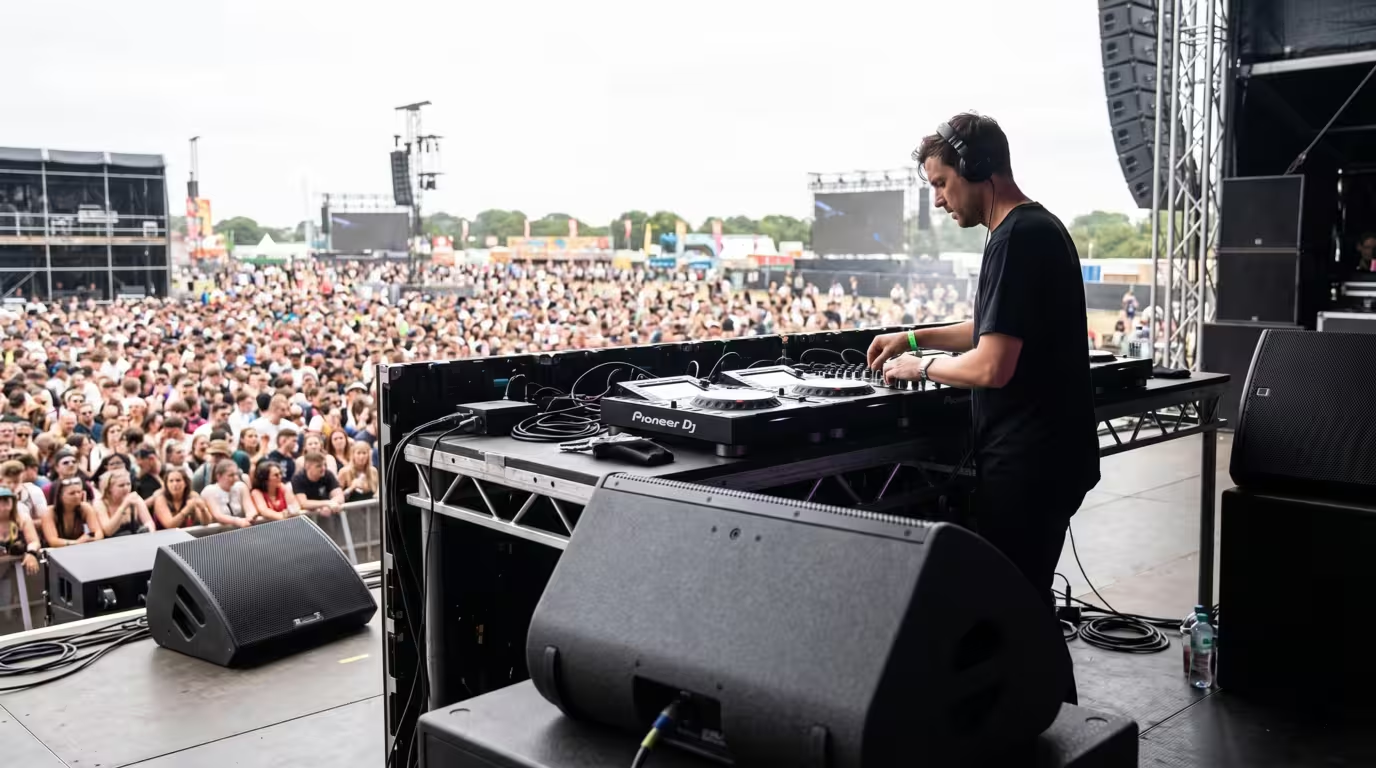
Festival stages almost universally provide the industry-standard Pioneer DJ / AlphaTheta setup: a row of CDJs (commonly CDJ-3000s) and a DJM mixer such as the DJM-A9 or V10, usually on a riser so the next act can be wheeled into place during changeover. The gear is the same the world over, which is exactly why it became standard — you arrive with a USB and a backpack, not a van of equipment, and major artists' technical riders routinely specify exactly this CDJ-plus-DJM rig.
FOH and monitor engineers
The crucial difference from a small club is that two separate engineers shape your sound. The front-of-house (FOH) engineer mixes what the audience hears, typically positioned out in the crowd at a control tower. The monitor (or foldback) engineer mixes what you hear on stage and is usually set up at the side of the stage so they can communicate with performers directly. As the Wikipedia entry on stage monitor systems explains, most mid-to-large venues run two complete systems — the main FOH system for the audience and a separate monitor mix for the stage, sent to wedge-shaped floor monitors or in-ear monitors. The practical upshot: if your booth monitor is too quiet or something sounds wrong, there is a specific person at the side of stage you can ask — and being clear, polite, and knowledgeable with them pays off. SoundGirls' overview notes the FOH engineer handles one mix for the whole crowd while the monitor engineer handles the performers' mixes.
Line-check, not soundcheck
Do not expect the full soundcheck you might get at a one-off club show. At a festival, changeovers are fast and you typically get only a line-check during the swap — enough to confirm signal is reaching the desk and your monitors are working. Live-sound professionals are consistent on this: acts lower on the bill usually just get a line-check during changeover, and a competent crew can dial things in quickly. Soundcheck and Venue Setup covers the line-check-at-changeover reality, and Connecting to a Club Sound System explains the booth-to-house signal chain and the engineer's role.
Outdoor sound and monitoring
Open air behaves differently from a club. Without walls to reflect or contain it, sound disperses, and wind, temperature, and humidity all bend and shift it over the course of a day — what sounds right at a 3pm line-check can change by sunset. The Prodigy's live engineer Jon Burton described in Sound On Sound how wind blows sound back onto the stage and away from the audience, and how festival engineers often walk up to an unfamiliar PA and mix from cold. Monitoring on an open stage can be harder than in a club — louder, with more spill — which is why many touring DJs lean on in-ear monitors for consistency, while others prefer loud wedges. EMA recalled a set where a 30-minute sound delay between booth and main system forced her to ditch the headphones, crank the booth monitors, and mix off them. The lesson: keep your expectations of stage sound realistic and stay adaptable.
Reliability and redundancy
A failure on a festival stage is loud, visible, and high-stakes in front of thousands and often livestreamed. Redundancy is not optional. Carry duplicate USB drives — at minimum one per deck plus spares — so a single corrupt or unreadable stick never ends your set. Preparing USBs for CDJs and Recovering From Equipment Failure cover the redundancy workflow in detail.
The October 2025 CDJ-3000 firmware episode is the cautionary tale. On 21 October 2025, Pioneer DJ released CDJ-3000 firmware version 3.30 to add support for its new OneLibrary format. As Resident Advisor reported when it broke the story, the update could make playlists disappear when a USB stick contained both the old Device Library format and the new OneLibrary export — tracks, playlists, and history all showing blank, even though the files were still physically on the drive. BBC Radio 1's Jaguar described the moment at London's DRUMSHEDS: she loaded both sticks and found her playlists, tracks and history all blank, and only finished because she was playing back-to-back and reached for an old backup USB. A string of other artists — including VTSS, Samurai Breaks, Tiffany Calver, Zoe London and Fleur Shore — reported the same blank-playlist nightmare. AlphaTheta pulled version 3.30 on 4 November 2025, two weeks after release, advising users to downgrade to version 3.20 for stable operation; its official notice stressed that in certain situations tracks or playlists didn't display on the CDJ-3000 but, importantly, no music or data was deleted. The festival-relevant takeaways: research the exact gear and firmware you will be playing on, prepare your library accordingly, keep a known-good backup, and remember that the FOH and monitor engineers and stage tech are there to help you problem-solve fast.
Stage presence without the gimmicks
A festival is more of a show than a club set, and a still figure staring at the decks reads as flat from a hundred metres away. Engaging a huge crowd means looking up, making eye contact across the field, raising a hand, cueing hands-up moments, and occasionally using the mic to lift the energy — and doing it for the cameras and screens as well as the people. The London Sound Academy's guidance on stage presence is blunt: standing still and not using your body is the fastest way to kill a vibe, and movement and showmanship are tools to communicate your enthusiasm.
But showmanship should serve the music, not replace it. As Magnetic Magazine observes, if you study a range of live sets you'll find most DJs simply fist-pump at the energetic sections — few are doing backflips, and you don't need to. Even Guetta admitted in his WIRED interview that the dramatic mixer-knob theatrics are a slightly silly part of the show. Be visible, animated, and generous with the crowd, but stay a DJ: the craft of selection and mixing is still what wins people over.
Preparation, the spectacle, and mindset
Festival sets are often more pre-planned than club sets, and at the very biggest stages they can be tightly scripted. Lighting, lasers, video, and pyrotechnics are frequently synchronised to the music using SMPTE/MIDI timecode, so the show hits every drop on cue. Pioneer DJ's own PRO DJ LINK technology and its free PRO DJ LINK Bridge app exist precisely to sync lighting, video displays and pyrotechnics with audio played on CDJs and DJMs, and third-party show-control software such as TC Supply's ShowKontrol does the same. Major EDM mainstages from EDC to Tomorrowland commonly rely on timecode to coordinate massive visuals and effects for headline acts.
That said, there is a genuine range. The biggest commercial mainstage shows may be heavily planned and timed to production; underground and boutique festival sets are often improvised and crowd-led, much like a club. Eric Prydz's elaborate EPIC and HOLO productions are notable partly because he insists on running them live rather than timecoded — the exception that proves how common timecoding has become. Decide where your stage sits on that spectrum and prepare accordingly.
Festival-specific preparation, building on the DJ Set Preparation Checklist, means researching the festival, the specific stage, your slot time and the day, the likely crowd, and the provided gear and firmware in advance. Prepare a tight, high-impact set or a strong set of key moments and anthems, have your IDs and edits ready, and rehearse and time it to the slot. Guetta told WIRED he spends up to a full month preparing a major festival set, building a skeleton while leaving room for spontaneity — a useful model even at a smaller scale.
Finally, the mindset. A festival is often a career-defining, high-pressure milestone, and nerves are normal. The antidotes are preparation and perspective: you are there to give the people in front of you a good time, not to perform for a phone screen. Arrive early — touring guidance commonly recommends being on site well before your changeover to clear accreditation, collect passes, and get to the right stage — respect your set time absolutely (a stage manager will cut an overrunning act, and overrunning is a serious breach that delays everyone after you), and then enjoy the moment. As Arielle Free put it, even if there's just one person standing there in a poncho in the pouring rain, your job is to make sure they have the best time of their life.
Key takeaways
• Festival sets are short and energy-first: get to your highlights fast, no long slow burn.
• The crowd is huge, diverse, and there for the lineup — play bigger, clearer, more recognizable moments.
• Two engineers run your sound: FOH out front, a monitor engineer at the side of stage; you usually get only a line-check at changeover.
• Build in redundancy — duplicate USBs and known-good firmware — because failures on a festival stage are brutal and public.
• Show presence and work the crowd, but let the DJing, not gimmicks, carry the set.
• Know your stage: mainstages can be heavily planned and timecoded; boutique stages stay closer to a club. Respect your set time and arrive early.
Ready-made, exclusive EDM tracks with full rights — released as your own.
