A booking agent can take a DJ from local rooms to international stages — but only once you have demand worth representing. Agents work on commission, so they amplify momentum you already have rather than create it from nothing. This guide explains what a DJ booking agent actually does, how the relationship works, and how to avoid the upfront-fee scams that prey on hungry artists. For booking yourself before you reach this stage, see our companion guide How to Get DJ Gigs.
What a booking agent actually does
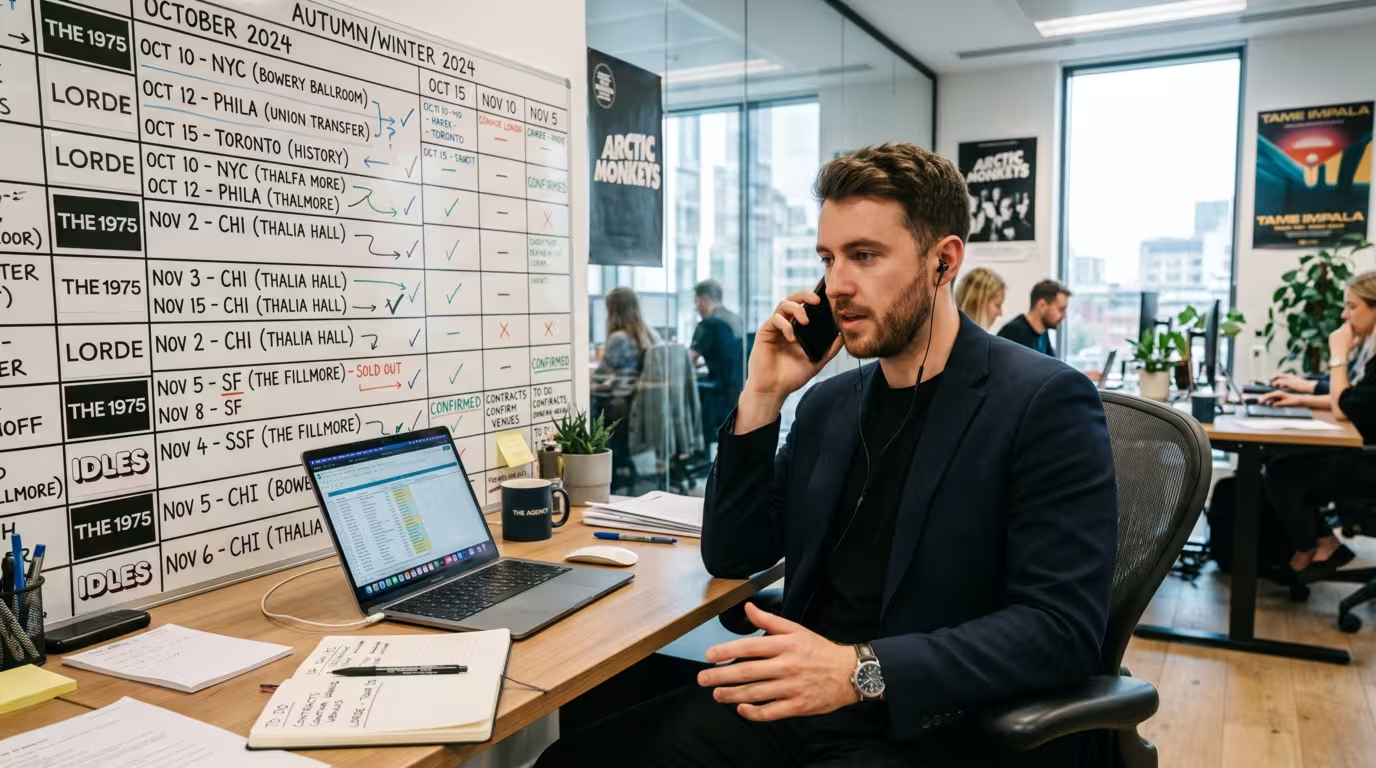
A booking agent is a person or company that finds, negotiates, and books live performances for an artist. As the Wikipedia entry on talent agents puts it, an agent finds work for performers and defends, supports and promotes their clients' interests — and in music specifically, booking agents are the people who actually book concerts for the artists they represent and make all the arrangements with the show promoters.
In day-to-day terms, a DJ's agent sources and secures gigs, pitches you to promoters and festival bookers, negotiates your fee and terms, issues and handles contracts, advances shows and coordinates riders with promoters, arranges travel and itineraries, and often routes tours so dates make geographic and financial sense. Berklee summarizes the role as working with artists to schedule concerts, tours and appearances and to negotiate the fees and contracts for them. Resident Advisor's feature on agents in electronic music describes a good agent as a co-pilot who helps steer the direction of an artist's brand and career, and as a shield who handles the good, the bad and the ugly so the DJ can focus on the music.
Crucially, the agent's value is their network. A booking agent has relationships with promoters, venue talent buyers and festival organizers that a rising DJ does not — and they leverage those relationships to get you booked, and booked better. Their entire job is to grow your live and touring career. (For the EPK they need to pitch you, see Building a DJ Press Kit; for advancing and riders, see DJ Riders Explained; for setting fees, see How Much DJs Charge.)
Booking agent vs. manager
The single most common confusion among rising DJs is conflating the agent with the manager. They are different roles. The booking agent is focused specifically on getting and booking live gigs and tours and negotiating those deals. The manager oversees your whole career and strategy — releases, brand, your team, long-term direction and day-to-day business. The Wikipedia entry on talent managers describes the manager's job as overseeing the day-to-day business affairs of an artist and advising them on professional matters while making long-term plans. Industry writers often call the manager the grand overseer of the artist's whole team, while the agent handles one spoke of the wheel: live performance.
These are also distinct from a publicist (press and image), a record label (releases), and a music lawyer (contracts). A small or rising DJ may have none of these, or one person wearing several hats — but you should understand the difference before you sign anything.
The pay structures reflect the scope. Agents take commission only on the live bookings they're involved in. Managers, by contrast, take a percentage of all your income — as Stagent's artist-management guide explains, a manager's commission covers income from all sources, including live performances, streaming royalties, merch and brand partnerships, whereas booking agents only earn commission on live performances. That broader scope is why management percentages run higher.
| Role | Focus | Typical pay |
|---|---|---|
| Booking agent | Live gigs and touring: sourcing, negotiating, booking, advancing | Commission on bookings, roughly 10-20% |
| Manager | Whole career: strategy, releases, brand, team, day-to-day | Percentage of all income, commonly 15-20% |
On management rates, music attorney Erin M. Jacobson notes that standard percentages usually sit at 15 to 20%, with 15% more common than 20%, and that she has seen them range from 10 to 25% only with special circumstances at either extreme. Billboard's reporting on what managers earn similarly puts the typical fixed commission at 15 to 20% of gross income, sometimes on a sliding scale — and notes that at superstar level rates tend to move lower, not higher. Treat all of these as typical ranges, not fixed rates.
When you're actually ready for an agent
Here is the reality that trips up most new DJs: because agents work on commission, they only take artists who can already generate bookings and income. An agent amplifies existing demand — they do not manufacture it from nothing. The London Sound Academy puts it bluntly: a DJ agent won't be interested unless you already have a steady stream of gigs, because they need to see you are in demand for paid work.
A Berlin-based agency writer framed readiness perfectly: you need an agent when you're so overwhelmed with bookings and emails that you can no longer focus on your craft. Before that point you need a certain level of standing in the market for the agency's network to build on; if you don't have gigs and promoters aren't showing interest, an agency has nothing to gain by working with you. Seeking an agent too early is one of the most common and costly mistakes. The honest sequence is: build your own bookings first (see How to Get DJ Gigs), then attract an agent when demand outgrows you.
Signs you may be ready:
• Consistent and growing demand for paid bookings
• More booking inquiries than you can comfortably handle yourself
• Gigs starting to come from beyond your local area, or touring on the horizon
• Releases, a residency or a rising profile creating genuine pull from promoters
If you've never played out and have no following, you're not ready — and that's fine. Everyone starts by booking themselves.
How agents work: commission, exclusivity and contracts
Commission
Music booking agents are paid by commission — a percentage of the performance fees of the bookings they secure. As Orphiq's guide to booking-agent contracts notes, the industry standard for established agents is 10% of gross, while higher percentages are common with smaller agencies or for developing artists who need more hands-on work relative to their earning potential. Stagent makes the same point about emerging acts: they often pay higher commissions of 15 to 20% because they require more work per booking, while established artists with strong demand may negotiate lower rates of 10 to 15%. Resident Advisor's agent feature describes the same split in electronic music — agents generally take ten percent for making the deal, rising to 15 to 20 percent when they handle more logistics such as itineraries, day-of troubleshooting, chasing invoices and visa or tax help. Treat any specific number as a negotiable starting point, not a law — and clarify exactly what the commission applies to (shows they book, or all shows).
Importantly, agent commission applies to live performance income only. An agent does not take a cut of your streaming, publishing, merch or brand deals — those are outside their remit.
Exclusivity and territory
Agents usually represent an artist exclusively for live bookings, often within a defined territory. That means booking inquiries get routed to your agent rather than handled by you directly. Many touring artists use different agents for different regions (for example, one for North America, one for Europe). Exclusivity is normal at a serious level — but the scope and length matter, and they're negotiable.
The representation agreement
The agent relationship is governed by a representation agreement covering term length, territory, exclusivity, commission, and often a sunset clause — the provision that lets an agent keep commission on shows booked during the term even if they take place after it ends. We cover the clause-by-clause detail in DJ Contracts Explained; the short version is to keep terms reasonable (shorter terms when testing a new relationship), push for a limited sunset period, and have a music lawyer review anything significant before you sign.
The basic flow is simple: a promoter contacts your agent, the agent negotiates the fee and terms, you perform, and the agent takes their commission from the fee.
How to get an agent
The hard truth is that you generally don't go out and get an agent — you become worth representing, and agents come to you (or respond when you reach out with a real track record). As one music-industry guide puts it, the goal is to reach the point where a great booking agent is trying to convince you to work with them, rather than the other way round.
Agents discover artists through buzz, recommendations and A&R. Resident Advisor's feature notes that the fastest way to get seen is to be pushed by a bigger artist, play artist showcases and work on collaborations, and that strong streaming and social numbers — a viral set, for example — get an agent's attention. Spotify for Artists quotes agents saying most artists they sign come from a relationship they already have with a manager or label, which is why a warm introduction beats a cold email almost every time.
What this means in practice:
1. Build a strong profile first — releases, a real following, a track record of gigs, and a current EPK (see Building a DJ Press Kit, Building a DJ Brand, and Social Media for DJs).
2. Network and earn recommendations — agents find artists through the scene, so relationships matter (see Networking in Dance Music).
3. Research and target agencies that fit your level and genre. DJ Times' advice for DJs seeking an agent is to find an agency that lives in your world — if you're a festival DJ, target an agency that works festivals, because the genre fit matters. Don't pitch a top-tier global agency before you're ready — a fitting smaller agency that's hungry for you beats a prestigious one that ignores you.
4. Be realistic and patient. Don't be pushy; as one top agent advised, when an agent is ready to make a move, they will.

How to work well with an agent
Signing is the beginning, not the end. The agent-artist relationship is a partnership, and the best ones rest on trust, communication and mutual effort.
• Communicate clearly and regularly. Expect and ask for updates during active booking periods, and keep your agent in the loop on new material, press and goals.
• Be professional and reliable. Show up and deliver on every gig they book. Your conduct reflects directly on the agent and the promoter relationships they stake on you — a no-show or a blown set damages their reputation, not just yours.
• Give them what they need: a current EPK, fresh mixes, your availability and routing preferences, your rider, and new music.
• Be responsive to time-sensitive offers, and trust their expertise — but stay informed about your own business.
• Keep producing and building your profile so they always have something to sell. Resident Advisor's feature warns against the passive I-have-an-agent-so-things-run-themselves mentality: the relationship only works if the artist keeps working on their music and profile and the booker follows with the right events. Over-reliance, one agent noted, becomes suffocating for the agent and frustrating for the artist.
The agent works for you, but you succeed together.
The value and the trade-offs
A good agent can be transformative; a bad or inactive one can stall you. Weigh both sides honestly.
| Pros | Cons |
|---|---|
| Access to the agent's promoter and venue network | Commission cost on your fees |
| More gigs, and bigger/better gigs | Exclusivity means less direct control |
| Professionally negotiated, often higher fees | You need enough demand to be worth their time |
| They handle booking admin and logistics | A poor or inactive agent can stall your career |
| Career and tour growth, plus added legitimacy | Less direct relationship with promoters |
The math only works if the agent meaningfully increases your show count and fees — enough that what you net after commission exceeds what you'd earn booking yourself. Below a certain level of demand, an agent has little to add.
Red flags and scams
This is the most important section for any new DJ. Legitimate booking agents work on commission and do not charge upfront fees. Any agent or agency that asks for money upfront — a registration fee, a listing fee, a monthly subscription to be on their roster, or a deposit to start representing you — is running a known music-industry scam. As one industry guide states flatly, if a booking agent is asking you for money to cover costs or fees, they are not for real. The blanket rule, in the words of another: don't pay upfront for services.
Veteran agent Tom Windish — now at Wasserman Music, and credited with developing the touring careers of Billie Eilish, Lorde, alt-J and The xx — made the same point on Ari Herstand's New Music Business podcast, calling paying to be on a tour a big red flag, with Herstand concluding it is flatly unethical to charge your openers to open for you. The principle is the same across the board: money should flow to the artist, not from them.
Other red flags to watch for.
| Red flag | Why it's a problem |
|---|---|
| Upfront, registration or listing fees | Legitimate agents earn commission only — this is the classic scam |
| Over-promising guaranteed gigs, fame or specific festivals | No honest agent guarantees outcomes |
| Can't name specific venues or promoters they work with | Suggests no real industry relationships |
| No roster of active touring artists | A real agent has a verifiable track record |
| Pressure into long or unfair exclusivity before proving themselves | Locks you in while they're untested |
| Taking commission on gigs you booked yourself, unfairly | "Double-dipping" — read the contract carefully |
| Inactivity — they don't actually get you gigs | A bad agent is worse than no agent |
Vet any agent before signing: look at their roster, their track record, and their reputation, and ask other DJs who've worked with them. Read the representation contract carefully (see DJ Contracts Explained) and have a lawyer review anything significant. Resident Advisor has also reported on overly long exclusivity and radius clauses hurting rising DJs — another reason to understand exactly what you're agreeing to. Remember: a bad agent is genuinely worse than no agent, because exclusivity can tie up your bookings while delivering nothing.
Practical tips and common mistakes
• Build your own demand before seeking an agent — they amplify momentum, they don't create it.
• Know the difference between an agent (live bookings) and a manager (whole career).
• Understand the commission, exclusivity and term you're agreeing to before you sign.
• Vet the agent and their roster; insist on references and a track record.
• Never pay upfront fees — that's the scam, full stop.
• Read the contract, and get legal eyes on anything serious.
• Be professional and reliable so you stay worth representing.
• Keep producing and building your profile; give your agent something to sell.
• Treat it as a partnership and communicate; don't go passive.
• A fitting smaller agency can beat a prestigious one that ignores you.
Key takeaways
• A booking agent finds, negotiates and books your live gigs and works on commission; a manager runs your whole career.
• Agents take roughly 10-20% of performance fees (commonly ~10-15%), usually represent you exclusively for live bookings, and sign artists who already have demand.
• You attract an agent by building buzz, releases, a following and a track record — then a warm intro beats a cold pitch.
• Legitimate agents never charge upfront fees; anyone who does is a scam.
• Work it as a partnership: be reliable, communicate, keep building — and read the contract before you sign.
Ready-made, exclusive EDM tracks with full rights — released as your own.
