Your DJ gear is expensive, portable, fragile, and you use it in crowded public spaces around alcohol — which is exactly why insurance and gear protection deserve a place in your business plan, not just an afterthought. This guide explains the main types of insurance DJs encounter, how policies actually work, and the non-insurance habits that keep your kit safe. It is general educational information only — not insurance, financial, or legal advice. Insurance products, terms, requirements, and prices vary enormously by country, state, and provider and change over time, so always read the policy documents and speak to a qualified insurance professional or broker about your own situation.
Why DJs should think about this
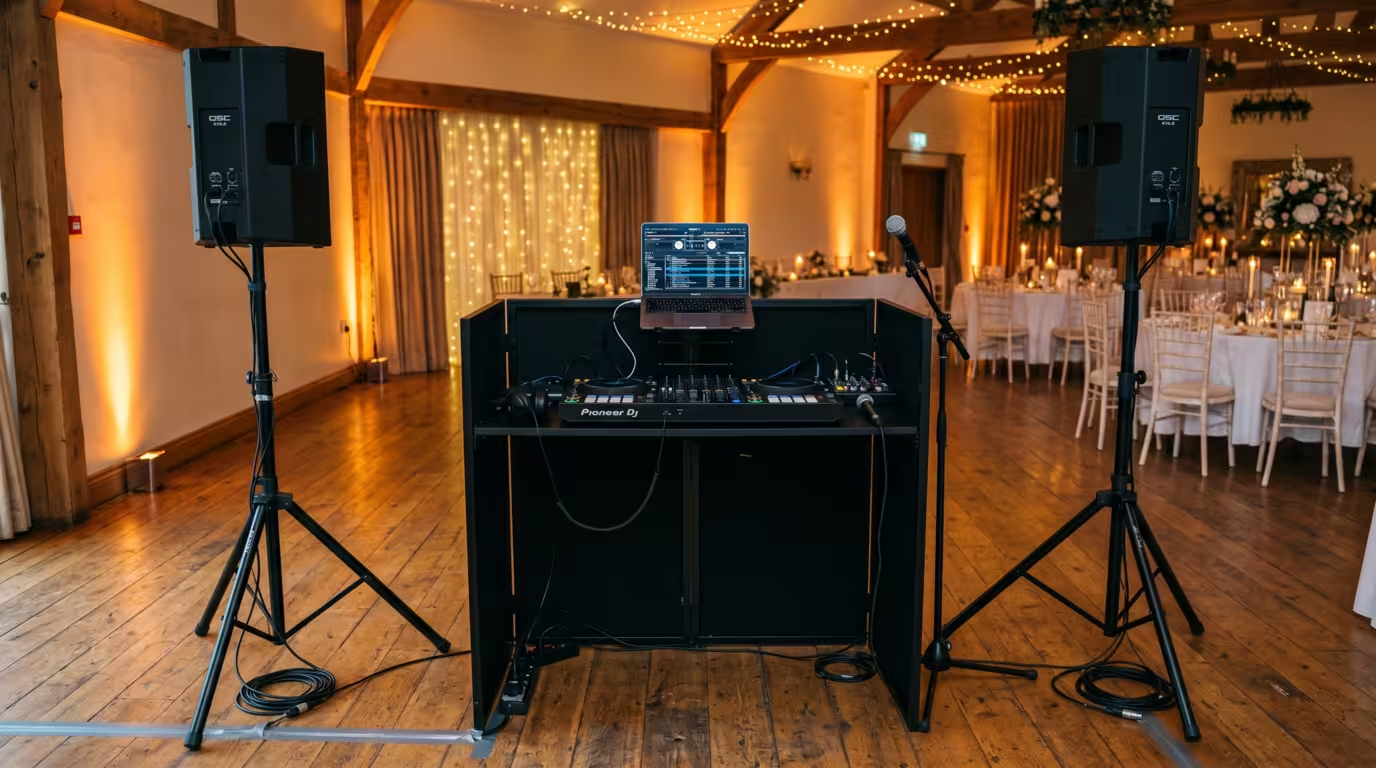
A working DJ carries an unusual combination of risks. You own thousands of pounds or dollars of controllers, CDJs, mixers, speakers, lighting, and laptops; you move it constantly; you set it up among guests who may be drinking and dancing; and your whole income depends on it arriving and working. Things go wrong in two broad directions. First, something of yours gets lost, stolen, or damaged — a dropped controller, a spilled drink on a laptop, a smashed car window with your bag gone. Second, you cause harm to someone else — a guest trips over your cable and breaks a wrist, or your speaker stand topples and scratches a venue's floor. The first is an equipment problem; the second is a liability problem, and they are covered by completely different things.
There is also a commercial reason. Many venues, hotels, and event organisers will not let you perform until you show proof of public/general liability insurance, usually in the form of a certificate of insurance (COI). This is covered in more depth in our DJ Contracts Explained and DJ Riders Explained articles, which look at the liability, indemnity, and insurance clauses you will meet in booking agreements. Insurance is the financial backstop; physical care and security are how you avoid needing it in the first place.
The main types of DJ insurance
DJ insurance is rarely one product. It is usually a bundle of separate covers, and the names differ by country. The table below summarises the main ones. Coverage names and availability vary by provider and territory — treat this as a general map, not a definitive list.
| Cover type | What it protects against |
|---|---|
| Public liability (UK) / General liability (US) | Third-party injury or damage to others' property caused by you or your gear |
| Equipment / gear cover (often "inland marine" in the US) | Your own gear: theft, loss, accidental damage, often in transit |
| Professional indemnity / errors & omissions | Claims you failed to deliver the service properly or were negligent |
| Employers' liability / workers' comp | Injury or illness to staff you employ |
Public liability / general liability
This is the cover venues care about most. Public liability insurance (the UK term) and general liability insurance (the US term) both protect you against claims from third parties — members of the public, guests, the venue — who suffer bodily injury or property damage as a result of your activities or equipment. The Wikipedia entry on liability insurance describes it as cover for those at risk of being sued by third parties for negligence. Classic DJ examples: someone trips over a trailing cable, a speaker stand falls on a guest, or you scuff a ballroom's wooden floor during load-out. The policy pays legal defence costs and any compensation awarded, up to the policy limit.
Coverage limits are quoted as illustrative ranges that vary by market and provider. In the UK, public liability is commonly offered at £1m, £2m, £5m, or £10m of indemnity — the Musicians' Union, for example, provides members public liability cover to a limit of £10 million per individual member (with a £100 excess on property-damage claims). In the US, venues commonly require $1 million per occurrence and $2 million aggregate. These figures are typical examples only and change; the right limit is whatever your venues and contracts require.
Equipment / gear cover
This is the one DJs most often overlook — and the most important distinction in this whole article. Public/general liability does NOT cover your own equipment. To protect your own controllers, decks, speakers, and laptop against theft, loss, or accidental damage, you need a separate equipment policy. The US insurer Thimble states it plainly: its general liability does not cover damage to or loss of your own DJ equipment, and for that you need a separate equipment policy (which it calls Business Equipment Protection). In the US this gear cover is frequently written as inland marine insurance — a category that, despite the nautical name, covers movable property on land, including equipment in transit and away from a fixed address. One DJ insurer, Insurance Canopy, reports from its own book of business that 90% of its claims come from damaged gear and 60% of its customers choose gear and equipment coverage — a single insurer's data rather than an industry-wide figure, but a telling sign of how real this exposure is.
When buying equipment cover, check three things. First, valuation: new-for-old (replacement cost) replaces gear with an equivalent new item, while indemnity (or actual cash value) pays the depreciated, second-hand value — so a five-year-old laptop might pay out far less than a new one. Second, whether high-value items must be individually specified or scheduled. Third, the territory — domestic only, or worldwide cover for overseas gigs.
Professional indemnity, employers' liability, and others
Professional indemnity (called errors and omissions in the US) covers claims that you failed to deliver the service properly — for instance a wedding client alleging you ruined their day by arriving late or playing the wrong set. It is relevant to some DJs, particularly weddings and corporate work, though many DJ policies include public liability only because that is what venues demand.
Employers' liability matters only if you employ staff — but where it applies it can be a legal requirement. In the UK, the Employers' Liability (Compulsory Insurance) Act 1969 requires most employers to hold this cover to a minimum of £5 million, and the Health and Safety Executive can fine an uninsured employer £2,500 for each day they are without valid insurance. In the US the rough equivalent is workers' compensation, also typically required once you have employees. Other covers DJs may meet include product liability, commercial/business contents, business income, and commercial auto for a gigging vehicle.
Packages
Many insurers sell DJ-specific or entertainer/musician policies that bundle public/general liability with equipment cover and sometimes more. In the US a Business Owner's Policy (BOP) commonly combines general liability with commercial property. Trade bodies also bundle cover into membership: the Musicians' Union includes public liability cover for performing members, and US associations such as the American Disc Jockey Association (ADJA) offer members access to group liability policies. These can be good value, but always check the policy wording rather than assuming the package fits you.
How insurance actually works
A handful of concepts unlock almost every policy document:
• Premium — what you pay for the cover, monthly or annually.
• Coverage limit / limit of indemnity — the maximum the policy will pay for a covered claim.
• Excess / deductible — what you pay out of pocket on each claim before the insurer pays the rest.
• Exclusions — what is NOT covered. Read these carefully.
• Certificate of insurance (COI) — a one-page summary proving a policy exists, which venues request; it is not the policy itself.
• New-for-old vs indemnity value — replacement cost versus depreciated value.
Exclusions are where DJs get caught out. Equipment policies very commonly restrict cover for gear left unattended, and for gear stolen from an unattended vehicle unless strict conditions were met. The Musicians' Union's instrument cover, for instance, excludes theft from an unattended vehicle unless the vehicle was fully enclosed, locked, with the gear hidden from view and all security used. Other typical exclusions are wear and tear, mechanical/electrical breakdown, and intentional damage. Declare your gear's value accurately: if you under-insure to save on premium, you may find a claim is reduced. And remember the COI is only proof — the policy document is the contract, so read it.
Who needs what
There is no universal answer, so scale your cover to your situation, your gear value, and your risk. The following is a general guide only.
A pure hobbyist mixing at home on inexpensive gear may need little beyond checking their home contents insurance — but here is a critical trap. Home and contents insurance very commonly excludes equipment used for business or taken out to paid gigs. UK guidance notes that running a business usually needs separate business insurance rather than a home policy, and US insurers similarly warn that homeowner's and renter's policies generally do not cover commercial property. If you earn money DJing, do not assume your home policy protects your kit at a gig — it very often does not.
A gigging, mobile, or wedding DJ realistically needs public/general liability (often required to get booked at all) plus equipment cover for their own gear. A club DJ who plays mostly on the venue's installed system has less personal liability exposure for the big sound system, but still has personal gear — laptop, headphones, USBs — worth insuring, and liability worth considering for the parts they bring and connect.
Protecting your gear physically
Insurance pays out after something goes wrong; prevention stops it happening. The table below maps practical measures to the risks they reduce.
| Protection measure | What it guards against |
|---|---|
| Flight cases, hard cases, padded bags | Impact, drops, dust, weather damage in transit |
| Never leaving gear unattended or in view | Theft at gigs, load-in/out, and from vehicles |
| Inventory: serial numbers, photos, receipts | Slow or failed claims; lost theft-recovery chances |
| Backups of your music library and USBs | Data loss, drive failure, lost or stolen sticks |
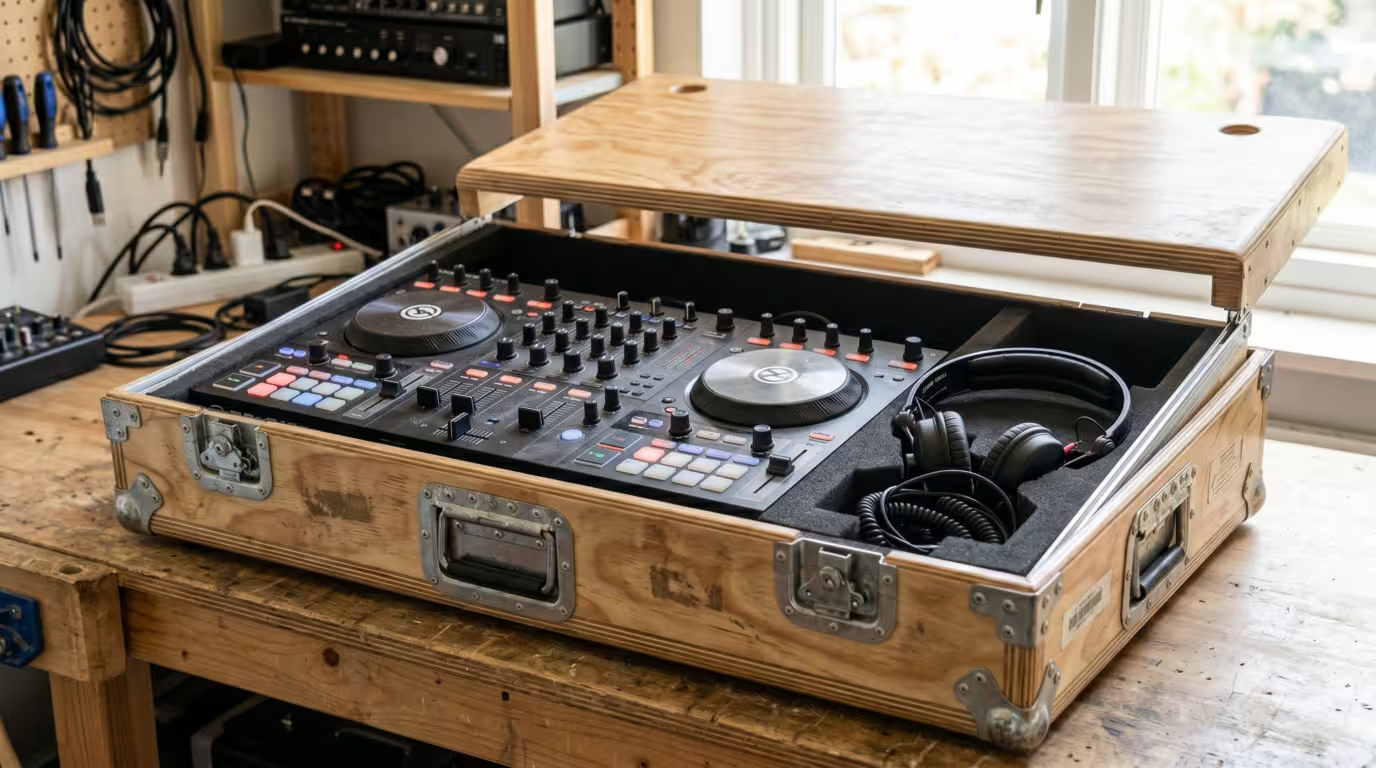
Cases and transport. A proper case is cheap relative to what it protects. Hard flight cases — plywood panels, metal corners, foam interiors — give maximum protection for touring and fly dates, while semi-soft zippered cases are lighter and fine for careful local transport. Secure gear in the vehicle out of sight, and never leave it visibly in a parked car. Be mindful of condensation when bringing cold gear into a warm venue — let it acclimatise before powering on. For day-to-day maintenance and cleaning, see our Caring for DJ Equipment guide.
Theft prevention. DJs are targets, and most thefts are crimes of opportunity. DJ TechTools and other industry writers consistently advise: use Kensington-style locks where your gear has the ports; keep your setup discreet; never leave a bag of gear unattended in the booth — ask for it to be locked in an office or keep your laptop on your person; and absolutely never leave gear in an unattended vehicle, which is both a theft magnet and a common insurance exclusion.
Inventory and records. Keep a written list of every item with its serial number, photographs, and receipts, stored somewhere safe (not only on the laptop that might get stolen). This is the single most useful thing you can do for both theft recovery and a smooth insurance claim — police can match recovered gear by serial number, and insurers can value your loss quickly.
Backups as protection. Your music library is effectively irreplaceable, and a corrupted USB or dead drive can sink a gig. Clone your performance USBs and keep a duplicate at home; back up your whole library to an external drive and/or the cloud; and crucially, do not carry your only backup drive in the same bag as your main rig — if the bag is stolen you lose both. For the detail on redundancy and packing, see our DJ Set Preparation Checklist and Preparing USBs for CDJs articles, and Recovering From Equipment Failure for handling a failure mid-set.
Practical steps
1. Assess your risk and gear value. Add up replacement costs and note where and how you perform.
2. Get appropriate cover. Liability if you gig or are required to; equipment cover for your own kit. Shop around, consider a broker, and look at DJ-specific or musician/entertainer policies.
3. Read the policy. Check limits, excess, valuation basis, territory, and especially the exclusions.
4. Keep an inventory. Serials, photos, receipts, values — kept off your main device.
5. Get your COI ready to send when a venue asks.
6. Protect gear physically — cases, secure transport, never unattended.
7. Back up your library and USBs.
8. Review cover whenever your gear or working pattern changes.
Common mistakes and tips
The biggest mistake is carrying no insurance at all — one theft or one liability claim can wipe out months of income. Close behind is assuming home contents insurance covers gigging gear (it usually does not), and under-insuring by declaring too low a value. Others: not reading exclusions (the unattended-vehicle trap catches people every year); having no proof of liability when a venue requires it, and losing the booking; keeping no inventory, which makes claims painful; leaving gear visible or in cars; not backing up the library; and skimping on cases. The fixes are the mirror image — scale cover to your situation, read the policy, keep records, protect physically, back up, use a broker or DJ-specific policy, and have your COI ready.
A note on variation and advice
Everything above is general educational information, not insurance, financial, or legal advice. Insurance products, terminology, coverage, legal requirements, and typical amounts vary by country, state, and provider and change over time, and all the figures here are illustrative examples rather than fixed rules. For decisions about your own situation, consult a qualified insurance professional or broker and read your actual policy documents.
Key takeaways
• Liability cover and equipment cover are different — public/general liability does NOT pay for your own gear.
• Venues commonly require proof of public/general liability (a COI) before they let you play.
• Home contents insurance usually excludes gear used commercially or taken to gigs.
• Read the exclusions — unattended and in-vehicle gear is a common gap.
• Prevention matters: cases, secure transport, an inventory, and backups protect what insurance only reimburses.
• Names, rules, and prices vary by country and provider — this is general info, not advice; consult a broker and read the policy.
Ready-made, exclusive EDM tracks with full rights — released as your own.
